
EU Bans PFAS Textile Auxiliaries Under REACH
On August 5, 2026, the European Commission published a REACH amendment, Commission Regulation (EU) 2026/1432, adding PFAS-based textile auxiliaries to Annex XVII, Entry 79. From the following day, the restriction became mandatory for textiles and related chemical equipment entering the EU market. For textile processing plants using PFAS-based water-repellent, oil-repellent, or stain-resistant finishes, as well as exporters of water-based dyeing and after-finishing equipment, this is a compliance event with immediate commercial relevance rather than a distant policy signal.
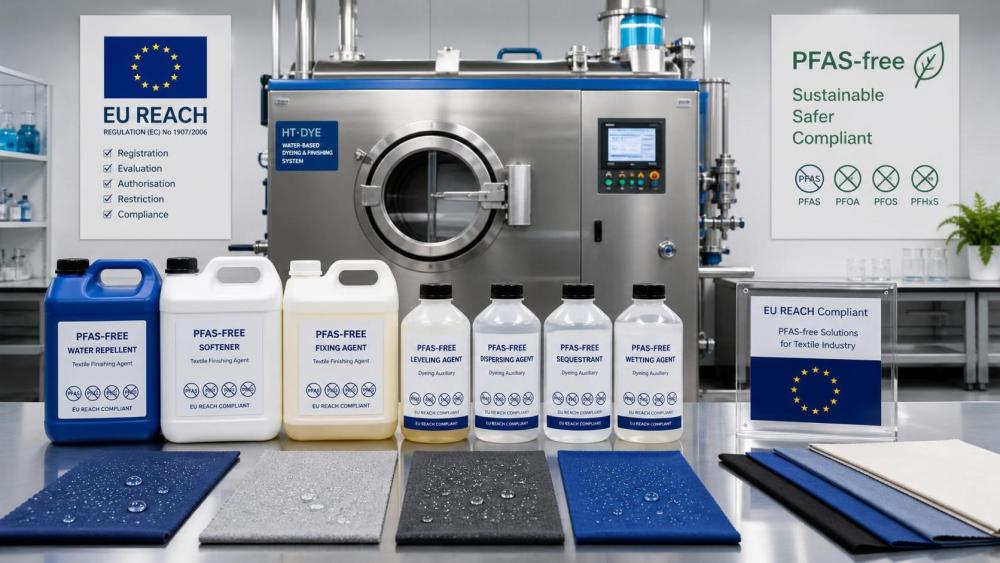
What the New REACH Restriction Confirms
The confirmed change is the formal inclusion of per- and polyfluoroalkyl substances (PFAS) textile auxiliaries in Annex XVII, Entry 79, under Commission Regulation (EU) 2026/1432. The restriction covers textile auxiliaries used for waterproofing, oil repellency, and anti-stain finishing. According to the provided information, the rule applies from the day after publication and covers all textiles and supporting chemical equipment entering the EU market.
The input also confirms that the measure directly affects exporters of water-based dyeing and after-finishing equipment, along with dyeing and finishing mills that use PFAS-based auxiliaries. Supply chain access linked to the ZDHC MRSL v4.0 certification framework is also identified as an affected area.
Where the Pressure Will Be Felt First
Export-facing textile processors
From an industry perspective, dyeing and finishing plants serving EU-bound orders are likely to face the most immediate pressure because the restriction directly concerns the use of PFAS-based textile auxiliaries in finishing processes. The impact is likely to show up in formulation review, customer order acceptance, and shipment readiness for goods intended for the EU market.
Suppliers of dyeing and finishing equipment
Exporters of water-based dyeing and after-finishing equipment may be affected because the rule, as described in the input, extends to related chemical equipment entering the EU market. Analysis shows that this creates a need to pay closer attention to how equipment is positioned, documented, and aligned with customer compliance requirements tied to PFAS-free processing.
Supply chain qualification under ZDHC MRSL v4.0
What deserves closer attention is the supply chain access issue around ZDHC MRSL v4.0. The provided information identifies this framework as an area affected by the restriction, which suggests that compliance is not only a customs or legal matter but also a supplier qualification issue. For companies already trading on restricted-substance credentials, the commercial effect may appear in onboarding, audit discussions, and approval status within customer supply chains.
Practical Priorities for Companies Now
Check whether current auxiliaries fall within the restricted scope
Companies handling EU-bound textile business should first verify whether waterproofing, oil-repellent, or stain-resistant auxiliaries in active use are PFAS-based. This is a practical starting point because the restriction is already in force from the day after publication.
Separate policy wording from shipment execution
Observably, one of the key operational questions is how the regulatory text translates into actual shipment control, customer document requests, and internal release procedures. Businesses should pay attention to the difference between knowing that the restriction exists and being able to demonstrate that a given product or process route is aligned with it.
Review supplier qualifications and compliance records
For mills, traders, and procurement teams, supplier credentials, technical declarations, and substance-related records are likely to become more important. This is especially relevant where ZDHC MRSL v4.0-linked supply chain access is part of customer requirements or vendor approval practice.
Prepare for customer communication and delivery risk
Analysis shows that companies exposed to EU orders should be ready for questions on input chemistry, finishing routes, and compliance status. The immediate applicability of the rule means that communication with buyers, contract counterparties, and relevant supply chain partners may become a core part of delivery management.
Why This Looks Like More Than a Short-Term Compliance Notice
This section is an editorial observation. It is more appropriate to understand this development as an immediate regulatory change with broader supply chain implications, rather than as a policy headline that can be monitored from a distance. The reason is not only the legal restriction itself, but the fact that it touches market access, chemical selection, equipment exports, and qualification systems already used in textile supply chains.
At the same time, it should not be overstated beyond the confirmed facts provided here. The current information establishes a clear rule change and identifies the business areas most exposed. Further interpretation of enforcement detail, customer implementation pace, and downstream commercial effects still requires continued observation.
How the Industry May Best Read This Development
In practical terms, this update matters because it moves PFAS textile auxiliaries from a compliance discussion into an active market-entry restriction for EU-bound business. For affected companies, the key issue is less about broad market sentiment and more about whether current products, process chemicals, equipment positioning, and supply chain documentation remain acceptable under the new rule.
Current observation suggests this should be read as an immediate compliance threshold and a longer-term signal for tighter material and supplier screening. It is not simply a temporary shift, but it also should not be treated as a complete picture of every downstream consequence before further verification.
Basis of This Article and What Still Needs Verification
This article is based on the user-provided news title, event date, and event summary concerning the August 5, 2026 REACH amendment and its stated impact on PFAS textile auxiliaries, textile imports, related chemical equipment, and ZDHC MRSL v4.0-linked supply chain access. For this type of industry update, relevant source categories typically include official regulatory notices, company disclosures, industry association updates, authoritative media coverage, and standard-setting or compliance framework documents.
A specific official source link was not provided in the input, so the exact source document path still needs ongoing verification. Follow-up attention should focus on any further official wording, market-side implementation details, and supply chain compliance interpretations connected to EU-bound textile and equipment trade.
Related News
- How to verify eco ink for digital textile printing meets ZDHC requirementsSep 13, 2026Dr. Elias Vance
- How textile finishing systems for polyester affect ZDHC complianceSep 01, 2026Dr. Elias Vance
- Can inkjet textile printing in Turkey meet ZDHC requirements?Aug 29, 2026Dr. Elias Vance
- How textile finishing technology affects color fastness and fabric hand feelAug 23, 2026Dr. Elias Vance