
Seamless Apparel Knitting Machines: Key Performance Metrics
Seamless apparel knitting machines sit at the intersection of speed, garment engineering, and flexible production. In real factory evaluation, machine value is not defined by headline RPM alone, but by how reliably the system controls loop formation, maintains yarn stability, supports style variation, and limits defects across long runs.
That is why performance metrics matter. For companies comparing seamless apparel knitting machines, the right indicators reveal whether a platform can deliver repeatable garment quality, shorter changeovers, lower waste, and stronger long-term operating economics in a market shaped by fast response, smaller batches, and rising sustainability pressure.
Why these machines draw so much attention
Seamless technology changes how apparel is produced. Instead of cutting and sewing many separate panels, garments are formed with integrated structures, zones, and transitions directly on the machine.
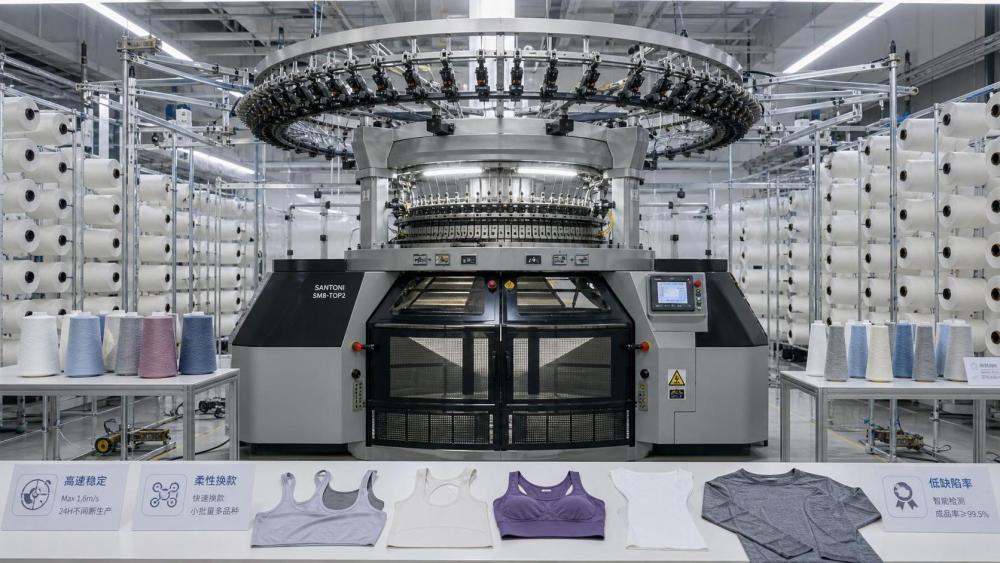
This matters in sportswear, underwear, base layers, shapewear, and fitted fashion programs. It also matters in sourcing decisions, because reduced sewing steps can improve throughput, consistency, and fabric utilization.
From the broader TMGS industry perspective, seamless knitting is part of a larger shift toward digitally managed textile production. The same factories reviewing weaving efficiency, AI inspection, automated cutting, and water reduction are also asking whether knitting systems can support faster and cleaner garment output.
What performance means in seamless knitting
In practical terms, performance is the machine’s ability to convert yarn into finished tubular or body-mapped garments with stable quality under commercial production conditions.
That definition sounds simple, but several variables interact at once. Needle action, feeder consistency, yarn tension, take-down control, lubrication, software logic, and pattern execution all influence the result.
A machine may look fast during a demonstration. Yet if it produces frequent barre, dropped stitches, uneven compression zones, or slow article changes, its effective performance is much lower than the sales specification suggests.
The metrics that deserve close comparison
When reviewing seamless apparel knitting machines, it helps to separate nominal machine data from production-relevant metrics. The table below highlights the measures that usually carry more decision value.
Loop formation is the first technical checkpoint
Loop stability often separates robust seamless apparel knitting machines from machines that only perform well under narrow conditions. Stable loop formation supports dimensional consistency, balanced elasticity, and predictable garment recovery after finishing.
It is especially important when producing body-mapped garments with compression zones, mesh structures, or plated yarn combinations. Small instability at knitting stage can become a visible fit problem later.
Yarn handling reveals machine maturity
Seamless apparel knitting machines are often asked to process elastane blends, microfilament yarns, functional fibers, and recycled inputs. These materials place greater demands on feeding accuracy and tension response.
A technically strong platform keeps yarn flow controlled during acceleration, deceleration, and pattern transitions. That reduces breakage events and improves knitting stability across different garment programs.
Where factories see the business impact
The commercial value of seamless apparel knitting machines appears in several places at once. Labor content can fall because fewer sewing operations are needed. Material loss can also drop because production avoids cutting many shaped panels.
More importantly, the machine supports a different production logic. Instead of relying on large batches to protect margins, operations can respond faster to style updates, seasonal demand, and replenishment cycles.
This fits a wider industry movement tracked by TMGS, where digital machinery, automation, and inspection systems are evaluated as connected investments rather than isolated assets. A knitting platform has more value when it works well with upstream yarn planning and downstream quality control.
Typical evaluation scenarios
Not every application asks the same questions. The most useful comparison starts with the production scenario rather than the brochure.
- For activewear programs, check structure accuracy in compression zones, ventilation mapping, and repeatability after washing.
- For underwear production, focus on hand feel, seam-free comfort, defect visibility, and consistent sizing.
- For small-batch fashion, style change speed and pattern versatility usually matter more than absolute output.
- For export-oriented supply chains, machine reliability, spare parts support, and software service access become critical.
In each case, seamless apparel knitting machines should be judged against the garment category, yarn structure, finishing route, and acceptable defect threshold.
Signals that a specification sheet may be incomplete
Some machine comparisons look clear until production details are examined. That is where hidden risk tends to appear.
- High speed data without reject rate information can mask poor real output.
- Wide style claims without sample evidence may indicate narrow process stability.
- Low energy figures without garment basis can distort cost comparison.
- Software features without workflow detail may hide long setup time.
- Mechanical reliability claims without maintenance intervals are hard to validate.
Usually, the best way to compare seamless apparel knitting machines is to ask for production data under similar yarns, gauge conditions, garment structures, and shift patterns.
How to build a stronger comparison framework
A practical review process combines machine metrics with process metrics. Looking only at technical specification values rarely produces the best decision.
Use a balanced scorecard
Score seamless apparel knitting machines across five linked dimensions: quality stability, style adaptability, operating efficiency, maintenance burden, and digital integration.
Check compatibility beyond knitting
The machine should fit wider factory systems, including inspection, production planning, finishing, and traceability. That matters even more in modern facilities using AI defect review, automated handling, or connected MES tools.
Measure consistency over time
One successful sample run is not enough. Reliable seamless apparel knitting machines prove their value through stable quality after repeated style changes, operator shifts, and long production cycles.
A useful next step
The most effective evaluation starts by ranking which metrics affect garment risk, output economics, and customer requirements in the intended product mix. After that, machine data becomes easier to interpret.
For anyone comparing seamless apparel knitting machines, it is worth building a shortlist around actual production evidence: loop stability, yarn behavior, defect performance, style change efficiency, energy per garment, and service support.
That approach creates a clearer path from machine specification to factory results. It also aligns with the TMGS view that smart equipment decisions should connect productivity, quality, flexibility, and sustainability into one measurable framework.
Related News
- When does seamless garment technology reduce production waste?Sep 14, 2026Yarn Topology Scientist
- What support should a seamless knitting systems supplier provide after installation?Sep 10, 2026Yarn Topology Scientist
- How closed loop knitting software reduces yarn waste in productionAug 30, 2026Yarn Topology Scientist
- What drives seamless garment technology price in large-volume production?Aug 20, 2026Yarn Topology Scientist